
Home / The Issues / SID&T Comment to CMS on Latest Proposed Rule
SID&T Comment to CMS on Latest Proposed Rule
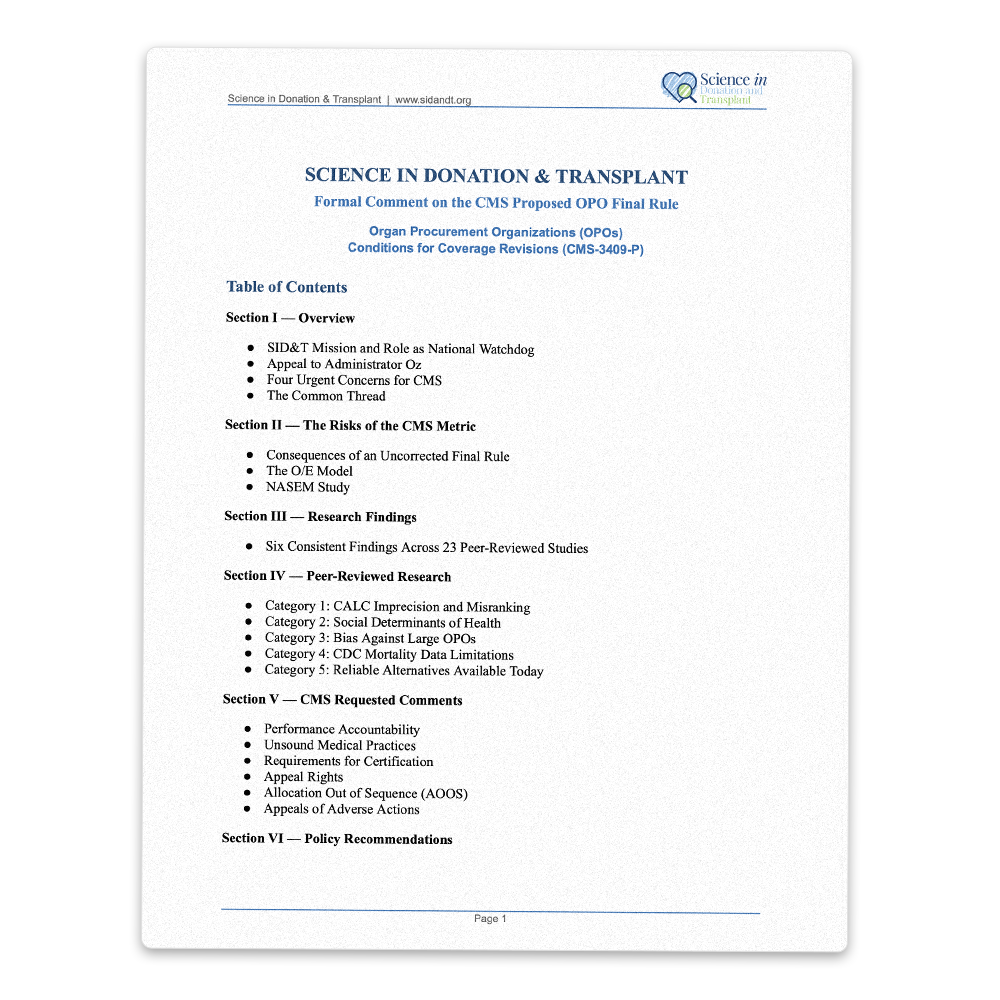
On Monday, March 10, 2026, Science in Donation and Transplant submitted a comprehensive commentary to the Centers for Medicare & Medicaid Services on the proposed final rule on Organ Procurement Organizations (OPOs) Conditions for Coverage Revisions (CMS-3409-P).
Table of Contents
Section I — Overview
SID&T Mission and Role as National Watchdog
Appeal to Administrator Oz
Four Urgent Concerns for CMS
The Common Thread
Section II — The Risks of the CMS Metric
Consequences of an Uncorrected Final Rule
The O/E Model
NASEM Study
Section III — Research Findings
Six Consistent Findings Across 23 Peer-Reviewed Studies
Section IV — Peer-Reviewed Research
Category 1: CALC Imprecision and Misranking
Category 2: Social Determinants of Health
Category 3: Bias Against Large OPOs
Category 4: CDC Mortality Data Limitations
Category 5: Reliable Alternatives Available Today
Section V — The Risks of the CMS Metric
Performance Accountability
Unsound Medical Practices
Requirements for Certification
Appeal Rights
Allocation Out of Sequence (AOOS)
Appeals of Adverse Actions
Section VI — Policy Recommendations
Section I: Overview
SID&T Mission and Role as National Watchdog
Science in Donation and Transplant (SID&T) is a non-profit organization devoted to advancing and safeguarding the world-leading United States organ donation and transplantation system and all its participants. We serve as a national watchdog, raising awareness on bureaucratic overreach and calling on agencies and Congress to use quality science to make healthcare policy. Our Advisory Board comprises national experts and leaders in organ transplantation and donation. SID&T provides access to peer-reviewed research, independent experts, and supporting documentation relevant to organ donation policy.
The Joint Commission Parallel
No one wants to protect underperforming OPOs or transplant centers. Similarly, CMS does not want to ignore underperforming hospitals. The difference is that CMS wisely delegates the responsibility for hospital evaluation and remediation to deemed accrediting bodies such as the Joint Commission, rather than to bureaucrats who lack the expertise to do so effectively.
The Collaboration Model: What Federal Oversight Should Strengthen
The United States has built the most advanced and successful organ donation and transplant system in the world, saving more than one million lives to date.
That achievement is not accidental. It is the result of decades of collaboration between donor hospitals, OPOs, and transplant centers working together toward a shared mission. As Dr. Anthony Watkins, SID&T Advisory Board member and surgical director of the Kidney and Pancreas Transplant Center at Tampa General Hospital, has written in the Tampa Bay Times: "Pitting Organ Procurement Organizations against transplant centers does not serve the patients or donor families we are all here to support." Tampa General led the nation in transplant volume in 2024, performing 889 lifesaving transplants. That success was built on strong collaboration between the transplant center and its regional OPO. That is the model federal oversight should strengthen, not dismantle.
Appeal to Administrator Oz
As a transplant surgeon, Administrator Oz understands what is at stake when policy diverges from medicine. We ask him to bring that understanding to bear on OPO oversight, ensuring that the professionals closest to the science, not the bureaucracy furthest from it, have the authority to evaluate and improve performance, as CMS already does with the nation's hospitals.
In this comment, Science in Donation & Transplant (SID&T) will address the many troubling elements in both the 2020 CMS Final Rule and in the latest organ procurement proposed rule: CMS Proposes Rule to Strengthen Oversight of Organ Procurement Organizations and Protect Patients. To support patients on the transplant waiting list, the selfless organ donors and their families, we urge CMS to base its policies and rules around organ donation and transplantation on evidence-based research.
Four Urgent Concerns for CMS
SID&T raises four urgent concerns on behalf of the donation and transplant community.
First, CMS cannot accurately assess true OPO performance using a metric that peer-reviewed science has repeatedly shown to be statistically fragile and structurally flawed. Decertifying the wrong OPOs based on a flawed metric does not improve the system. It endangers the patients that our system exists to serve.
Second, four active federal lawsuits now challenge the Final Rule on grounds of scientific insufficiency and procedural failure. If CMS does not correct course, regulatory oversight of organ procurement will be ceded to the judiciary, an outcome that serves no one.
Third, limiting the appeal rights of Tier 2 OPOs while federal courts are already scrutinizing the rule's legal foundation is neither fair nor defensible. Due process is not optional.
Fourth, the peer-reviewed science challenging the Final Rule has been consistently dismissed by HHS and CMS leadership. That pattern of ignoring independent research is not reform. It is the continuation of a decades-long bureaucratic failure that SID&T has documented in detail at sidandt.org.
The Common Thread
These four concerns share a common thread: policies that ignore science do not strengthen the donation and transplant system; they put it at risk. SID&T urges CMS to correct course before irreversible harm is done.
Section II: The Risks of the CMS Metric
Beginning in 2026, as many as two-thirds of the nation's nonprofit Organ Procurement Organizations could face decertification under CMS's current Tiered ranking system, based on its faulty metric. A substantial body of peer-reviewed research demonstrates serious problems with the metric. Over twenty independent studies have shown that the CMS metric is mathematically incapable of producing accurate rankings.
Consequences of an Uncorrected Final Rule
If left uncorrected, the CMS Final Rule will:
Decertify 40 to 70 percent of OPOs beginning in 2026
Shut down high-performing OPOs while leaving historically weaker performers in place
Systematically misclassify OPOs serving large, diverse, and medically complex populations
Give an unjustified advantage to OPOs serving small, less diverse, homogeneous regions
Open up Donation Service Areas to inexperienced OPOs, potentially including for-profit OPOs for the first time in US history.
Destabilize and potentially collapse the most successful organ donation system in the world
Reduce transplant candidates' access to lifesaving organs
Invite continued federal litigation that could strip CMS of regulatory authority
Wrongful decertification risks creating more donation and transplant deserts
There is no evidence to suggest that more than half of these essential organizations should be dismantled, especially given that progress is accelerating at the local and national levels. Records in organ donation and transplantation continue to be broken year over year. In fact, 85% of OPOs are operating within 1 Standard Deviation from the mean, even based on the CMS faulty metric. The current rule provides no meaningful support for OPOs to adopt or improve best practices. It punishes differences without distinguishing harmful variation from healthy adaptation to local needs, and it sets the stage for disputes, appeals, and court fights rather than steady progress.
Implement an O/E Model for OPO Oversight
The current CMS Final Rule ranks OPOs against one another using standardized rates and national percentiles, but never evaluates performance relative to predicted donor potential. That is a fundamental flaw.
CMS should shift to an Observed-to-Expected (O/E) model, an approach recommended by the Scientific Registry of Transplant Recipients in 2020 and widely recognized as the gold standard in healthcare performance measurement. O/E is already used to evaluate both hospital mortality and transplant center outcomes, comparing actual results to risk-adjusted predictions based on case mix, demographics, and clinical characteristics.
In organ donation, that formula is straightforward: Actual Donors divided by Hospital-Referred Donor Potential. It measures performance against verified clinical data rather than relative national rankings, and it is the standard that CMS should apply here.
NASEM Study Provides a Guide for Reform
Echoing the uninformed media campaign targeting OPOs, CMS argues that OPOs’ performance failures were to blame for the nation’s chronic shortage of organs for transplant. The bipartisan, Congressionally mandated 2022 study by the National Academies of Sciences, Engineering, and Medicine (NASEM) directly contradicts the advocacy narrative framing OPOs as the problem. Key conclusions in the report are:
The U.S. wastes too many usable organs primarily due to transplant center acceptance practices, not OPO performance. The so-called discard rate has reached 30% at times.
The average kidney patient who died while waiting had been offered 16 kidneys that were transplanted into other patients.
"It is too easy for transplant centers to decline usable organs."
Equity gaps (especially for Black patients) must be addressed through system-wide, aligned metrics, not isolated punishment of OPOs.
The evidence is not in dispute. Over twenty peer-reviewed studies, four active federal lawsuits, and a Congressionally mandated National Academies report all point to the same conclusion: the current CMS metric is scientifically unsound, structurally biased, and operationally dangerous. The NASEM report makes clear that the real drivers of organ waste and equity gaps lie in transplant center practices and system-wide misalignment, not in OPO performance.
Yet CMS continues to pursue a decertification framework that punishes the wrong organizations, ignores the right data, and puts the most vulnerable patients at greatest risk. Reform is not only possible but also overdue, as CMS’s oversight has been found wanting for 25 years, as evidenced by the documented failures of its metrics. The science, the solutions, and the will to act are all within reach.
Section III: Research Findings
Since the CMS Final Rule was implemented, 23 peer-reviewed studies have been published in leading medical journals evaluating the OPO performance metric. The research concludes that the current CMS OPO metric is unstable, biased, and statistically unreliable. Here are six consistent findings:
1. The CMS Metric Uses a Flawed Denominator
The CMS metric uses a flawed denominator to estimate donor potential. CMS currently relies on CDC mortality data and the CALC methodology. Research demonstrates this denominator:
Relies on a single cause-of-death diagnosis
Uses high-level mortality estimates rather than more accurate clinical referral data
Assumes uniform donor potential across hospitals and service areas
Fails to account for demographic and socioeconomic variation
2. The CMS Metric Misranks OPOs
The CMS metric uses a flawed denominator to estimate donor potential. CMS currently relies on CDC mortality data and the CALC methodology. Research demonstrates this denominator:
20% to 43% tier changes when alternate denominators are used
36% to 41% of OPOs change tiers year-to-year
11% to 29% shift tiers depending on the data source (the studies compare CDC Mortality data determined Donor Potential (CALC) to hospital discharge diagnosis data (CALC Adjusted).
This level of volatility indicates instability and unreliability
3. The Metric Is Biased Against Large OPOs
The CMS methodology produces systematic volume bias unrelated to quality. Simulation studies show:
The smallest OPO was incorrectly placed in Tier 1 72% of the time
The largest OPOs can rarely reach Tier 1, even when performance is equal
Large OPOs have a 95% probability of needing to recompete under certain scenarios
Small OPOs have as little as a 26% probability
4. The Metric Fails to Adjust for Social Determinants of Health
The metric measures demographics rather than performance. The CMS metric does not adjust for race, Area Deprivation Index (ADI), or community-level social capital. Research shows:
16% to 41% of OPOs change tiers when ADI is incorporated
8 OPOs shifted tiers when race adjustment was applied
OPOs serving racially and ethnically diverse communities are disproportionately penalized
The increased odds that OPOs serving disadvantaged communities will be shut down expose members of vulnerable populations awaiting transplants to a greater risk that service disruptions will cost them their opportunities to receive life-saving gifts
5. One-Year Measurement Is Statistically Fragile
36% to 41% of OPOs change tiers from one year to the next
24 of 58 OPOs lie within 5% of a tier edge
Tier 1 and Tier 2 OPOs can be separated by as little as 0.01%
6. CDC Mortality Data Is an Inadequate Proxy
Researchers consistently conclude that reliance on CDC mortality data reduces the validity of the results, with death certificates found to be inaccurate up to 60% of the time and varying by state. The CALC denominator:
Relies on death certificate data widely acknowledged to contain inaccuracies
Cannot exclude non-ventilated deaths
Is constrained by statutory limitations under the Public Health Service Act
7. Hospital Referral Data Is Available and Feasible
CMS acknowledged in 2020 that hospital referral data is the most accurate denominator but declined to use it, citing concerns about feasibility. Research demonstrates:
95%+ of referrals can be accurately categorized using EMR and donor records
Referral data allows an objective clinical assessment of donor potential
The data is verifiable and technically feasible to implement
Taken together, these six findings point to a single, unavoidable conclusion: the CMS OPO performance metric is not measuring what it claims to measure. It misranks organizations, penalizes diversity, advantages smaller and less complex regions, and relies on data that independent researchers have consistently found to be inaccurate and inadequate. Most critically, the gold standard alternative is not theoretical. Hospital referral data is available, verifiable, and technically feasible today.
CMS has no scientific justification for continuing to base decertification decisions on a metric that 23 independent peer-reviewed studies have found to be fundamentally flawed. The evidence points clearly to a better path. SID&T respectfully urges CMS to take it before decertification decisions produce consequences that cannot be undone.
Section IV: Peer-Reviewed Research
We grouped the 23 research articles into five categories based on their findings and provided a link to each article for your review.
Category 1: Mis-Ranking of OPO Performance Due to CALC Imprecision (Studies 1-7)
Prediction of Cause, Age, and Location-Consistent Deaths: A Useful Tool to Identify Areas for Improvement for Organ Procurement Organizations, J. Miller, et al.; American Journal of Transplantation (AJT), Volume 24, Issue 6, Supplement 1. June 2024. https://www.amjtransplant.org/issue/S1600-6135(24)X0006-4
Evaluation of the Stability of Organ Procurement Organization Performance Metrics; Lopez, Rocio et al. Am J Transplant. 2025 Oct;25(10):2151-2160. https://pubmed.ncbi.nlm.nih.gov/40409471/
Significant Discrepancies to Evaluate Organ Procurement Organization Performance Based on Exclusion Criteria, J. D. Schold, et al.; ATC 2023 Poster Abstracts, AJT, Volume 23, Issue 6. https://www.amjtransplant.org/article/S1600-6135(23)00475-6/fulltext
Are the Centers for Medicare & Medicaid Services metrics evaluating organ procurement organization performance too fragile? Jesse D. Schold et al. AJT, Volume 24, Issue 6, June 2024. https://www.amjtransplant.org/article/S1600-6135(24)00222-3/fulltext
Concordance by Data Source for Defining Donor Potential Using Cause, Age, and Location Consistent with Donation; J. Schold et al. AJT Volume 23, Issue 6, June 2023. https://www.amjtransplant.org/article/S1600-6135(23)00474-4/fulltext - Abstract #566
Stability of New CMS Metrics for Organ Procurement Organizations: Comparison of 2 Consecutive Years, A. Israni, et al. AJT Volume 23, Issue 6, June 2023. https://atc.digitellinc.com/p/s/stability-of-new-cms-metrics-for-organ-procurement-organizations-comparison-of-2-consecutive-years-35289
OPO Measured Donation Rate is Highly Volatile Year to Year and Not a Stable Quality Indicator, J. Schold, R. Lopez. AJT Volume 23, Issue 6, June 2023. https://www.amjtransplant.org/article/S1600-6135(23)00475-6/fulltext
Category 2: Impact of Disregarding Social Determinants of Health (Studies 8-15)
Centers for Medicare and Medicaid Services Performance Metrics and the Disproportionate Impact of Decertifying Organ Procurement Organizations on Minority Populations. Rodrigue, James R. et al. Transplantation, January 21, 2026. DOI: 10.1097/TP.0000000000005646. https://journals.lww.com/transplantjournal/citation/9900/centers_for_medicare_and_medicaid_services.1270.aspx
Evaluation of the stability of organ procurement organization performance metrics, Lopez, et al. AJT, Volume 25, Issue 10, 2151-2160. https://www.amjtransplant.org/article/S1600-6135(25)00281-3/abstract
Adjusting for race in metrics of organ procurement organization performance, Miller, Jonathan M. et al. AJT, V olume 24, Issue 8, 1440-1444. https://www.amjtransplant.org/article/S1600-6135(24)00122-9/fulltext
Impact of Area Deprivation Index on Organ Procurement Organization Performance Metrics, J. Schold, et al. AJT, Volume 23, Issue 6. https://www.amjtransplant.org/article/S1600-6135(23)00474-4/fulltext
Population Characteristics and Organ Procurement Organization Performance Metrics, Rocio Lopez et al. JAMA Network Open. 2023;6(10):e2336749. https://jamanetwork.com/journals/jamanetworkopen/fullarticle/2809988
Adjusting for Race in Metrics of Organ Procurement Organization Performance, J. Miller, et al. Am J Transplant. 2024 Aug;24(8):1440-1444. https://www.amjtransplant.org/article/S1600-6135(23)00475-6/fulltext
Examination of Racial and Ethnic Differences in Deceased Organ Donation Ratio Over Time in the US, Amber B. Kernodle et al. JAMA Surg. 2021;156(4):e207083. https://jamanetwork.com/journals/jamasurgery/fullarticle/2776217
Does Social Capital Explain Community-Level Differences in Organ Donor Designation? Milbank Q. 2015 Sep;93(3):609-41. https://onlinelibrary.wiley.com/doi/10.1111/1468-0009.12139
Category 3: Statistical Bias Against Large OPOs (Studies 16-19)
Association of Organ Procurement Organization Volume With CMS Performance Evaluations, Rocio Lopez et al. AJT, V olume 25, Issue 5, 1013-1020. https://www.amjtransplant.org/article/S1600-6135(24)00737-8/pdf
Are the New CMS Performance Tiers Biased against Larger OPOs? G. Lyden et al. AJT, Volume 24, Issue 6, June 2024. https://www.sciencedirect.com/science/article/abs/pii/S1600613524007378#:~:text=This%20study%20aimed%20to%20examine,of%20care%20and%20transplant%20rates.
Reducing Bias against Larger Organ Procurement Organizations in Performance Evaluations, G. Lyden, et al. AJT, V olume 24, Issue 6, June 2024. https://www.amjtransplant.org/issue/S1600-6135(24)X0006-4
The CMS proposed metrics for recertification of organ procurement organizations: Evaluation by the Scientific Registry of Transplant Recipients, Jon J. Snyder, et al. AJT, Volume 20, Issue 9, 2466-2480. https://www.amjtransplant.org/article/S1600-6135(22)22564-7/fulltext
Category 4: CDC Mortality Data Limitations (Study 20)
National Death Index Users Guide, CDC; National Center for Health Statistics. National Death Index User's Guide. Hyattsville, MD. 2013. https://www.cdc.gov/nchs/data/ndi/2024-NDI-User-Guide.pdf
Category 5: Reliable Alternative Measures Available Today (Studies 21-23)
Direct Measurement of DCD Donor Potential. Mone, Tom et al. Transplantation 109(4):p 715-719, April 2025. DOI: 10.1097/TP.0000000000005188. https://journals.lww.com/transplantjournal/fulltext/2025/04000/direct_measurement_of_dcd_donor_potential.24.aspx
A Fairer and More Equitable, Cost-Effective, and Transparent System of Donor Organ Procurement, Allocation, and Distribution, Ken Kizer, et al. National Academies of Sciences, Engineering, and Medicine. 2022. https://www.nationalacademies.org/publications/26364
Assessment of National Organ Donation Rates and Organ Procurement Organization Metrics. Zhou Y , Marrero WJ, et al. JAMA Surg. 2021;156(2):173-180. https://jamanetwork.com/journals/jamasurgery/fullarticle/2773525
Section V: CMS Requested Comments
The following addresses the areas where CMS requested comments on the Final Rule.
Performance Accountability
True performance accountability requires measuring the right organizations on the right outcomes. CMS currently tiers OPOs based in part on transplant results they do not control, while HRSA continues to overlook significant and well-documented disparities in how transplant centers accept and use available organs. Holding OPOs accountable for outcomes outside their authority, while failing to hold transplant centers accountable for outcomes within theirs, is not accountability. It is a misdirection, and it has consequences: inaccurate rankings, erosion of public trust, and federal litigation that now threatens to remove CMS's oversight authority entirely.
What is needed is not a punitive or adversarial approach. Instead, federal oversight should encourage collaboration, innovation, and shared accountability. CMS should measure outcomes that matter, reward real gains, and give organizations the tools to improve. As SID&T Advisory Board members have written, the rule should set clear standards based on proven steps: growing donor designation, improving organ recovery, strengthening OPO and transplant hospital teamwork, and ensuring fast and safe organ transportation. These steps are evidence-based, teachable, and trackable. They drive improvement rather than punishment and respect real differences among communities and hospitals.
Unsound Medical Practices and Media Misinformation
CMS proposes adding "unsound medical practices" as a basis for urgent decertification without providing a formal definition of the term. Using undefined language as the trigger for one of the most consequential regulatory actions available to CMS is neither fair nor legally sound. Before this provision moves forward, CMS must define the term with precision and establish clear, evidence-based criteria for its application.
This matters especially now, because a wave of sensationalized media coverage has promoted the false narrative that OPOs remove organs before patients have died. That claim is factually wrong and legally impossible under current federal law. The Uniform Anatomical Gift Act, adopted by all fifty states and the District of Columbia, explicitly prohibits OPOs from any involvement in the declaration of death or in any medical treatment of a patient. OPO recovery teams do not touch a donor until a hospital physician has independently declared death. A mandatory waiting period follows that declaration. If a physician's declaration is premature, OPO personnel can identify and report it, as has occurred, but they cannot cause it to be premature, and OPOs have no authority over the transfer of a living patient to the operating room.
Organ transplantation leaders writing in Undark (Jedediah Lewis, Hedi Aguiar, And Adam Schiavi, “Misinformation About the End of Life Is Harming Organ Donation,” Undark, October 23, 2025, https://undark.org/2025/10/23/opinion-misinformation-organ-donation/) stated that the media coverage has confused fundamental issues, noting that the alleged errors would have occurred regardless of whether the patient was a registered donor, because they involved physician decisions about withdrawing life-sustaining treatment, not the organ donation process itself.
The consequences of this misinformation are measurable. Thousands of Americans removed themselves from donor registries in 2025, directly harming patients who depend on the system. HHS and CMS have a responsibility to correct the public record, not remain silent while false narratives erode decades of public trust.
SID&T applauds HHS's requirement that OPOs appoint patient safety officers to monitor and conduct real-time root cause analyses of safety events. That is a meaningful step. But safeguards have always been central to this system. The priorities must remain safety and science, not sensationalism.
When an OPO receives a 2 a.m. call from a hospital about a potential donor, the OPO team is looking out for patients, exploring every viable way to turn tragedy into a lifesaving gift. That is the reality of what OPOs do. Federal oversight should reflect that same spirit: one of collaboration, trust, and a shared commitment to saving lives. The current sensationalist and inaccurate media narrative, met with silence from CMS, has undermined that spirit and damaged the public trust that underpins the entire system.
Requirements for Certification
What CMS describes as administrative refinements to OPO certification requirements are, in substance, a significant reinterpretation of statutory authority. CMS has reassessed its historical reading of the OPO Certification Act of 2000 and now concludes that nothing in the Public Health Service Act limits the Secretary to recertifying only pre-2000 OPOs. CMS grounds this position in statutory text, legislative history, and recent Supreme Court precedent.
SID&T does not oppose competition or innovation. But this reinterpretation deserves serious scrutiny. Opening the door to new OPO certification while the existing metric cannot accurately evaluate the performance of current OPOs is premature at best and dangerous at worst. Certifying new entrants into a system governed by a flawed and legally contested oversight framework does not enhance competition. It compounds an already unstable situation.
CMS frames this proposal as a response to concerns about market consolidation. That framing sidesteps the more fundamental question: if the current metric cannot reliably measure who is performing well and who is not, on what basis would CMS evaluate any new OPO, or justify displacing an existing one?
Any pathway to new OPO certification must be built on a scientifically sound and legally defensible performance framework. That framework does not yet exist.
CMS should also establish a second path to compliance through national accreditation by independent experts, modeled on how hospitals are reviewed today. CMS already uses independent professional survey and accrediting bodies for hospital oversight. The same tools can and should be applied to organ procurement organizations. This would create meaningful accountability without forcing every region into the same regulatory mold, and it would align OPO oversight with the professional standards model that has served hospital oversight well for decades.
Appeal Rights
CMS proposes revisions that would distinguish non-renewal of an OPO agreement from decertification, limit the appeal rights of Tier 2 OPOs that lose competitions, and adjust notice requirements across the tiered recertification system. SID&T urges CMS to carefully reconsider these proposals, as they raise serious legal and procedural concerns that go beyond administrative refinement.
The foundation of this concern is straightforward. CMS has long maintained an ambiguous characterization of its relationship with OPOs, describing them as neither traditional providers nor suppliers. But the operational reality is unambiguous. CMS requires OPOs to submit cost reports, subjects them to adjudication of kidney reimbursement rates, and mandates specific overhead allocation to kidney recovery costs. These are the defining characteristics of a provider relationship, not a supplier relationship.
Suppliers operate under fee-for-service contractual arrangements and do not require cost reports. CMS routinely extends full appeal rights to providers under its agreements and regulations. To strip those rights from Tier 2 OPOs that lose a competition is to treat them as suppliers while continuing to impose provider-level obligations on them. That is legally inconsistent and fundamentally unfair.
There is no basis in federal law or regulation for this conversion. If CMS intends to eliminate appeal rights for Tier 2 OPOs, it must first relinquish the cost report requirement and all associated provider-level obligations. It cannot maintain the burdens of a provider relationship while removing its protections.
Allocation Out of Sequence
The United States leads the world in organ donation and transplantation by nearly every measure. Yet it also has the highest rate of recovered organ non-use in the developed world. Nearly 10,000 transplantable organs went unused last year. Understanding why requires context that the current federal oversight framework has failed to provide.
The rise in recovered organ non-use must be understood in its proper context. It is in significant part a response to the dramatic expansion of the donor pool, as OPOs now recover organs from older and more medically complex donors, and as donation after circulatory death has risen to surpass brain death as the primary pathway to donation. These are organs that would never have been recovered a decade ago. The system is succeeding in procurement in ways previously impossible.
The challenge now is to ensure that transplant centers are equipped, incentivized, and accountable for effectively using these more complex organs. Non-use in this context is not a failure of the donation system. It is a consequence of its success, and it demands a different kind of response than the one currently being pursued.
The current debate over Allocation Out of Sequence frames the issue as a choice between equity and utility. That framing is false and counterproductive. Equity and utility are not competing values in organ allocation. They are complementary goals that a well-designed system should pursue simultaneously. HHS, CMS, HRSA, OPTN, OPOs, and transplant centers must operate as a unified system with aligned metrics and shared accountability, not as competing interests pulling in opposite directions.
OPTN has asserted that allocating outside its defined match run does not reduce organ non-use and that higher rates of allocation out of sequence correlate with higher non-use rates. SID&T disputes this conclusion. No peer-reviewed study or randomized trial supports it. The assertion appears to rationalize a system that consistently underperforms on utilization while deflecting scrutiny from the transplant center practices that are a primary driver of organ non-use.
The Accelerated Kidney Placement program illustrates this failure clearly. Acceleration was introduced only after organs had already been declined by multiple transplant programs locally and regionally. By that point in the process, meaningful improvement in utilization was unlikely. The intervention came too late, and the removal of the functional Donor Service Area structure created new barriers to placing hard-to-use organs, ironically worsening the equity outcomes the program was designed to improve.
The deeper problem is the transplant center's behavior and incentive structure. Transplant centers are currently evaluated primarily on one-year survival rates, which creates a rational but system-damaging incentive to decline marginal organs rather than accept them. The Scientific Registry of Transplant Recipients documents wide performance variation among transplant centers, yet that variation receives far less regulatory scrutiny than OPO performance. This misalignment between what is measured on the donation side and on the transplant side is at the heart of the non-use problem. Metrics must work together, not in opposition.
Our donation and transplant system was established in 1984. It has not fully adapted to more than 40 years of medical advancement that now allow OPOs to recover far more challenging yet viable organs than were possible in earlier decades.
The true challenge belongs to transplant centers, which must develop the capacity, transparency, and accountability to use these organs effectively. Hard-to-place organs that can and do save lives every day must be directed toward centers most likely to use them. That has never been adequately incorporated into allocation policy, and it must be now.
HRSA has gone so far as to suppress taxpayer-funded independent research that challenges its allocation conclusions. That is not an oversight. It is the suppression of the science on which oversight depends, and it is precisely the kind of transparency failure that makes system-wide alignment impossible.
Outright censorship took place at the 2024 American Transplant Conference in Philadelphia. The Scientific Registry of Transplant Recipients (SRTR), under federal contract to provide statistical and analytical support for the development of US organ and transplant policy, was scheduled to present two peer-reviewed papers. The abstracts for those papers were attached to the digital agenda for the meeting, which all participants received and downloaded.
https://sidandt.org/news/vital-news-updates/hrsa-continues-its-heavy-hand-of-censorship?rq=censorship
The papers were entitled “Are the New CMS Performance Tiers Biased against Larger OPOs?” and “Reducing Bias against Larger Organ Procurement Organizations in Performance Evaluations,” both authored by G. Lyden et al. The first paper used 100,000 statistical simulations to prove that “the CMS evaluation system as currently defined is biased against larger OPOs, with smaller OPOs having a higher probability of being automatically recertified or being able to compete for renewal of their contracts.” The second paper proposed a solution to the identified statistical bias: An “alternative tiering system” based on Observed-to-Expected rate ratios. This study ran 30,000 simulations to conclude that O-to-E method removed the bias while continuing “to detect underperforming OPOs.”
Just hours before the planned presentations, HRSA cancelled them and removed both papers from the agenda. Dr. Suma Nair, HRSA’s Associate Administrator for the Health Systems Bureau, explained to attendees that the decision was made because “We want to refrain from publicly questioning the Final Rule.” The episode is discussed in depth in The American Journal of Transplantation in its January 2025 issue (Jesse D. Schold, Timothy L. Pruett, Elizabeth A. Pomfret, Ty B. Dunn, “The Dangerous Precedent Of Censoring Scientific Dissemination,” AJT, January 2025 https://www.amjtransplant.org/article/S1600-6135(24)00555-0/fulltext).
What is called for is better alignment, increased transparency, and best-practice communication between OPOs and transplant centers. A dynamic allocation model that incorporates transplant center behavior and organ non-use patterns is essential. When the donation side and the transplant side are measured by metrics that work together toward shared goals, equity and utility both improve. That is the standard federal oversight should aim for.
Appeals of Adverse Actions
The decision to limit appeal rights for OPOs facing decertification cannot be separated from a more fundamental question: if the metric driving those decertifications is scientifically unsound, stripping appeal rights does not protect the system. It protects the metric.
A January 2026 study published in Transplantation by Dr. James R. Rodrigue and colleagues adds to a growing body of peer-reviewed evidence demonstrating that the CMS OPO performance metric is fundamentally flawed. Most critically, the research shows that the CMS metric measures demographics, not performance, penalizing OPOs based on the communities they serve rather than the quality of their work.
The Metric Penalizes the Wrong Communities
Rodrigue and colleagues also found that OPOs serving racially and ethnically diverse populations are far more likely to be placed in lower performance tiers, not because of poor performance, but because CMS relies on unadjusted death certificate data that ignores social determinants of health. Communities already facing the greatest barriers to healthcare access are therefore at the greatest risk of losing their local donation infrastructure. This is precisely the outcome the Congressionally mandated NASEM report warned against, calling for system-wide aligned metrics rather than isolated punishment of OPOs serving underserved populations.
High-Performing OPOs Will Be Misclassified
The Rodrigue study confirms what multiple prior studies have shown. The CMS Final Rule misclassified capable, high-performing OPOs as failing because it relies on data that does not accurately identify true donor potential, does not account for hospital referral patterns or structural inequities, and confuses data limitations with organizational failure. Organizations with strong hospital relationships, effective donor family support, and solid donation outcomes are at risk of decertification, not because of what they have done, but because of where they operate and who they serve.
Disruption Without a Plan
CMS has offered no guidance for how donation services will be maintained if OPOs are shut down across large geographic regions. There is no plan for continuity of donor family support, no strategy for maintaining hospital relationships built over decades, and no framework for preventing donation slowdowns or organ loss during transitions. The current rule sets the stage for disputes, appeals, and court fights rather than steady progress, and it punishes differences without distinguishing harmful variation from healthy adaptation to local needs.
Abrupt decertification without a transition strategy does not strengthen the system. It destabilizes it at precisely the moment when donor families and transplant candidates need it most.
Bad Data Yields Bad Results
OPO performance should be evaluated using clinically meaningful measures such as ventilated hospital deaths and organ yield, not raw death certificate data that was never designed to identify eligible donors. The gold standard, Actual Donors divided by Hospital-Referred Donor Potential, is now technically feasible and verifiable. CMS has no scientific justification for continuing to rely on a proxy measure that 23 independent peer-reviewed studies have found to be inaccurate, unstable, and inequitable.
Using the wrong data produces the wrong results. And in organ donation, the wrong results cost lives.
SID&T supports reform grounded in science, transparency, and best practices. The full body of peer-reviewed research and the recommendations of the Congressionally mandated NASEM report point clearly toward a better path. Real reform measures performance accurately, accounts for community context, supports organizations in improving, and protects patients and donor families who depend on a stable, trustworthy system.
Section VI: Policy Recommendations
To prevent unnecessary disruption, policymakers should:
Align donation and transplant-side performance metrics so that OPO procurement incentives and transplant center acceptance incentives work together rather than at cross-purposes, with shared accountability for organ utilization outcomes
Require CMS to use hospital-verified imminent death referrals and death referrals
Use OPTN policy-defined Exclusion Criteria to rule in or out referred possible donors to remove concerns about OPO self-reporting
Adopt the CMS hospital practice of independent accrediting bodies to assess OPO performance
Rely on multiple measures of OPO performance, as recommended by NASEM
Replace tier rankings with standard deviation-based evaluation
Replace confidence interval ranking with Observed-to-Expected (O/E)
Incorporate appropriate social determinants of health
Include assessment process measure performance that is required by Congressional statute, and a core element of hospital and transplant center certification by accrediting bodies
Evaluate performance using multi-year data rather than a single year
Establish a national accreditation pathway for OPOs modeled on the independent accreditation system CMS uses for hospital oversight, providing a second path to compliance that rewards collaboration and improvement.
Pause decertifications until methodological corrections are implemented
The recommendations above are not a call to abandon accountability. They are a call to get it right. The United States has built the most successful organ donation and transplant system in the world through collaboration, science, and the generosity of donors and their families. That system deserves oversight that is accurate, equitable, and grounded in the best available evidence. Twenty-three peer-reviewed studies, a Congressionally mandated National Academies report, four active federal lawsuits, and the voices of the nation's leading transplant professionals all point in the same direction. The science is clear, and the solutions are available. What is needed now is the will to act before decertification decisions produce consequences that cannot be undone, and patients pay the price for policies that should never have been implemented.